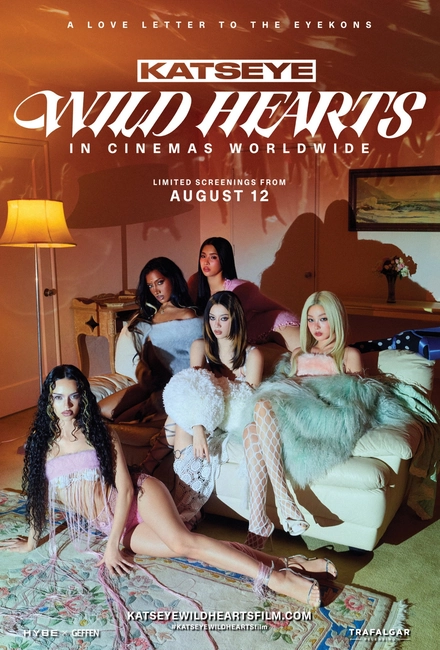
'Wild Hearts' Formalizes Katseye's Post-Reality-Show Narrative
The film is more a retrospective of the group’s history than a lead-up to the album.

/fotos_autores/Snapinsta.app_407515194_3575940449294932_1641519103342892776_n_1080.jpg)

/uploads/conteudo/fotos/katseye_topo.jpg "Scene from KATSEYE: Wild Hearts (Reproduction)")
Image credits: Scene from KATSEYE: Wild Hearts (Playback)
The scene director Nadia Hallgren chooses to open the documentary KATSEYE: Wild Hearts with is an emblematic one: the moment on the reality show Pop Star Academy when the group’s final six members were revealed. Not coincidentally, Hallgren also directed that program, in which labels HYBE and Geffen joined forces to find the next “global pop sensation,” blending a distinctly South Korean training and promotion model with an audition process and, as a result, a completely international lineup.
Wild Hearts, then, is more of a sequel to Pop Star Academy than anything else. In fact, despite being sold that way, it barely works as a “warm-up” for WILD, KATSEYE’s EP that came out just a few days after the film’s theatrical debut. The movie barely touches on that new record or the process behind it, positioning itself much more as a biographical piece than as an artistic behind-the-scenes documentary. More The Rose: Come Back to Me than BTS: The Reunion, to cite two titles from a similar vein.
The good news is that Hallgren, having followed KATSEYE’s formation firsthand, understands the group’s ethos and the individuality of its members well enough to craft a feature that continues this story smoothly. And at 1 hour and 20 minutes, the documentary wastes no time on anything that isn’t essential from the little over two years since the end of Pop Star Academy – the release of the group’s very first single, “Debut,” for instance, is left out in favor of highlighting KATSEYE’s first real hit, “Touch.”
From there, it jumps to the first shows, the group’s initial connection with fans, and eventually the image transformation cemented in “Gnarly.” After that comes a tour through all the major milestones in their career growth (Billboard records, festival performances), a brief sketch of the members’ personalities and how they connect, and one or two exchanges about KATSEYE’s relationship with its public reception and celebrity status. Lots of fan service, lots of aspirational messaging, few thorns.
Ultimately, the job of Wild Hearts is to build—or at least solidify—a narrative: presenting KATSEYE as a group united by talent, but embraced by the public as a cultural phenomenon, representative of a new way of making pop and pop stars. Instead of relying on traditional news coverage, for example, Hallgren weaves TikTok videos into the behind-the-scenes footage and interviews that form the backbone of her film. Alongside editor Betsy Kagen, also returning from Pop Star Academy, she creates a product that is above all dynamic, but never feels devoid of meaning, not least because its inside-out perspective offers valuable insights to the audience.
And in that sense, Wild Hearts is a faithful document of the cultural entity it portrays, even if shaped by the needs of the company that financed it. Like so many other films of this kind, it matters more as a record of the “official history” than as an artistic expression. KATSEYE is an important part of our pop continuum, whether the viewer likes it or not, and this is the story KATSEYE wants to tell about itself. For that reason alone, it’s already worth paying attention.
KATSEYE: WILD HEARTS
KATSEYE: WILD HEARTS